

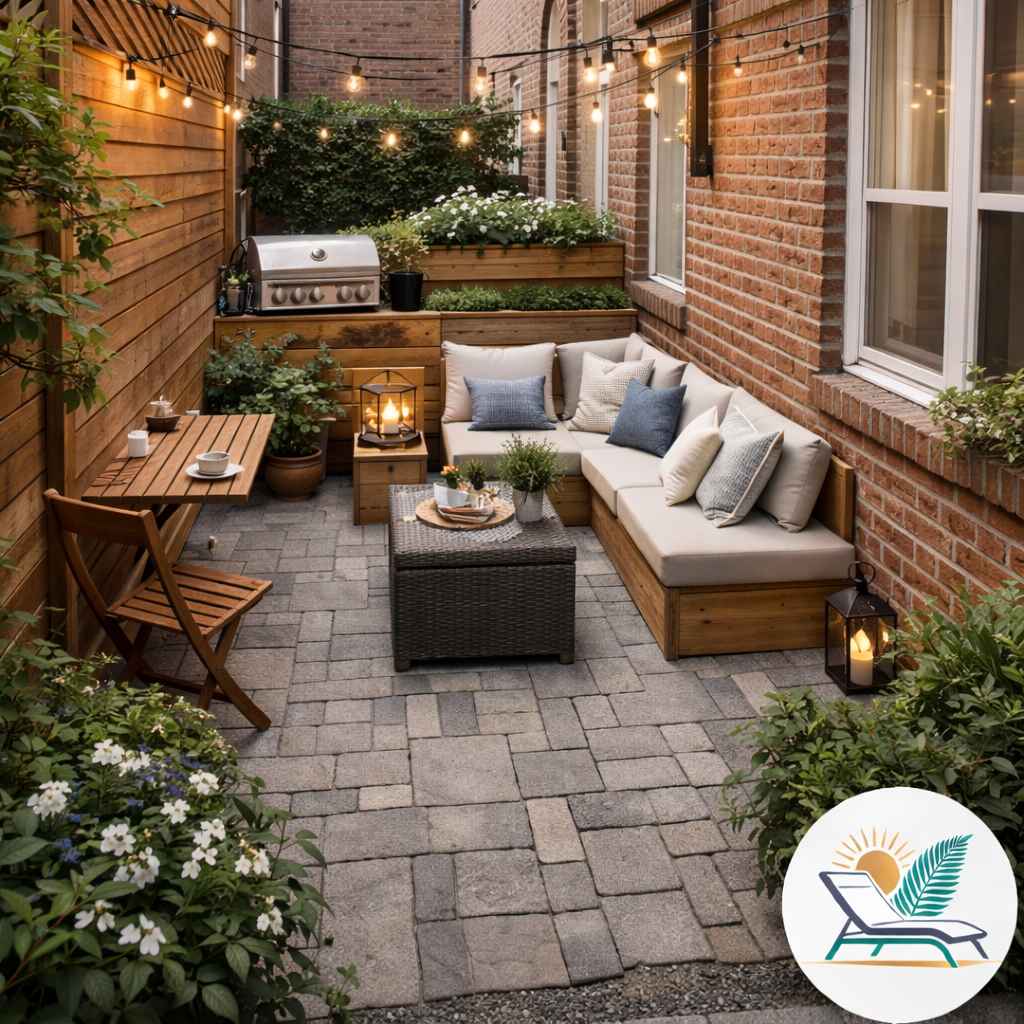


A small patio turns ugly fast: chairs become obstacles, doors can’t swing, and every meal outside feels like furniture Tetris. The cost isn’t just comfort. It’s the constant friction of moving things, scraping walls, and abandoning the space because it’s always “in the way.” Small home patio ideas only work when they respect one brutal truth—your patio has to stay walkable, even when it’s set up. That means choosing what never moves, what folds, and what earns its footprint. If you’re deciding between “cute” and “usable,” choose usable. A small patio that functions looks better than one that photographs well once.
Door Swing and Walk Lines Decide the Entire Layout
Small home patio ideas fail when the door is treated like an afterthought. A patio door needs a clear swing zone and a landing area where you can step out without turning sideways. If the first step outside hits a chair leg, the patio becomes a storage zone, not living space.
Measure the door swing and mark a straight walk line to the main “sit” spot. That path must stay open. The constraint is simple: you don’t have extra inches to waste on accidental traffic. If your patio is narrow, push seating to one side and keep the other side as a clean lane.
Failure mode shows up in two weeks: you start “temporarily” parking items in the path. Shoes, watering cans, a spare chair. The lane disappears, and suddenly no one uses the patio.
The decision lever is fixed placement. Anchor one element—usually a slim bench or narrow bistro set—so the path stays predictable. Small home patio ideas are less about adding and more about refusing clutter at the doorway.
Choose One Seating Type and Refuse the Mixed Set Trap
A small patio can’t carry a loveseat, two chairs, a table, and “maybe a pouf.” Mixing seating types looks flexible, but it eats clearance from every angle. Small home patio ideas work best when the seating acts like one unit.
Pick either a bench-based setup or a two-chair setup. A bench wins in tight rectangles because it can sit flush to a wall and still seat two. Chairs win when you need to rotate and tuck them. The constraint is your usable width, not your total square footage.
The failure mode is buying “just one more seat” because guests might come. That extra chair becomes a permanent obstruction, and the patio feels smaller than it is.
Your decision lever is seat count discipline. If you host rarely, plan for daily comfort first and add temporary stools only when needed. Small home patio ideas should protect everyday flow, not rare events.
Go Vertical With Walls, Rails, and Corners Without Making It a Shed
The most reliable small home patio ideas move storage off the floor. Floors are for feet. Walls are for function. Hooks, narrow shelving, and rail planters can carry tools, lanterns, and herb pots without shrinking walk space.
The constraint is weather exposure. Anything you mount needs to survive rain, sun, and wind without warping or becoming rusty junk. Use exterior-rated hardware and keep shelves shallow. Deep shelves turn into clutter magnets.
Failure mode: vertical storage becomes a dumping zone. You start stacking random items because “it’s up off the floor,” then the patio looks like the back of a garage.
The decision lever is category limits. Assign the wall one job—plants, lighting, or small tools—not all three. If you want plants, commit to a clean row of containers. Small home patio ideas should look intentional, not like you ran out of room indoors.
Use a Fold-Down Table That Locks Flat, Not a Wobbly Hack
A fold-down wall table is one of the strongest small home patio ideas for tight spaces because it creates a dining surface only when you need it. But it has to lock solid. Wobble kills confidence, and then nobody uses it.
The constraint is mounting surface. If your exterior wall is uneven, soft, or poorly anchored, you’ll get bounce and sag. Use proper wall anchors for masonry or studs for framed walls. If you rent, choose a freestanding drop-leaf table that tucks against a wall.
Failure mode: people buy the cheapest fold table, it flexes, and it becomes a plant stand. You lose the whole point—usable space that disappears.
The decision lever is stability over style. Choose a table depth that fits plates without forcing elbows into the rail. Small home patio ideas succeed when the “temporary” surface feels permanent while it’s open.
Build a Storage Bench That Solves Two Problems at Once
Storage benches are classic small home patio ideas because they combine seating and hiding power. The trick is choosing one that doesn’t steal legroom or block the door.
The constraint is lid access. If the bench lid needs a full arc to open, you’ll never use it in a tight patio. Look for front-opening doors or lids with slow-close hinges that don’t require you to clear the entire top.
Failure mode: the bench becomes a soggy box. Cushions go in wet, mildew appears, and suddenly your “storage” is a problem.
The decision lever is ventilation and liners. Use a bench with airflow or add a breathable liner bag for textiles. Only store items that can handle humidity. Small home patio ideas should reduce maintenance, not create a new chore.
Pick a Rug That Defines Zones Without Shrinking the Room
A rug can make a small patio feel finished, but the wrong size makes it look cramped. Small home patio ideas treat the rug like a boundary line for furniture, not a decoration.
The constraint is drainage. Outdoor rugs trap moisture underneath if the patio can’t dry. Choose breathable materials and lift the rug occasionally. Size matters too: a rug that’s too small looks like a bath mat and makes furniture feel scattered.
Failure mode: you choose a tiny rug because it’s cheaper, then the chairs sit half on and half off, creating visual mess and tripping edges.
The decision lever is proportion. Let the rug tuck under the front legs of seating or cover the entire seating zone. Keep a clear strip near the door so dirt and water don’t end up indoors. Small home patio ideas need the rug to support flow, not fight it.
Lighting That Doesn’t Eat Floor Space Changes Night Use
When a patio is small, floor lamps and chunky lantern stands are dead weight. Smart small home patio ideas use overhead or wall-mounted lighting so the floor stays open.
The constraint is power and exposure. If you don’t have an outlet, rely on solar or rechargeable fixtures. Wind matters too; lightweight lights swing and break. If you use string lights, anchor them tight so they don’t droop into your sightline.
Failure mode: too many lights. A small patio lit like a festival feels chaotic, and cords become hazards.
The decision lever is one lighting “spine.” Run one clean line—string lights along a rail, a single wall sconce, or two slim lanterns hung from hooks. Small home patio ideas should make the patio inviting at night without turning it into a wiring project.
Planters Should Act as Edges, Not Random Objects
Plants sell the feeling of a patio, but in small spaces they must behave like architecture. The best small home patio ideas use planters to define edges, hide ugly views, or create privacy without blocking movement.
The constraint is weight and water. Heavy planters can crack tiles or stain concrete. Dripping water makes floors slippery. Use trays or self-watering inserts, and keep planters grouped, not scattered.
Failure mode: “plant creep.” You start with two pots, then add five more, and the patio becomes a maze.
The decision lever is the perimeter rule. Keep plants along the boundary lines—against the rail or wall—and keep the center clean. Choose taller, narrower planters for privacy instead of wide ones that steal walking space. Small home patio ideas should make the patio feel bigger by clearing the middle.
A Real Scenario: The 2-Meter Patio That Finally Worked
In a small apartment row, Sara had a narrow patio—about two meters wide—with a door that swung outward. She bought a cute café set. The first week, she scraped the door on the chair. The second week, she started leaving the chairs inside. The patio became unused.
Two friction points were obvious. One: she kept chasing “more seating,” which killed the walk line. Two: she stored watering cans and shoes outside because it felt convenient, turning the door area into clutter.
The fix wasn’t a makeover. It was a decision. She committed to small home patio ideas that protected a clear lane: a wall-mounted fold table on the right, a slim storage bench on the left, and two chairs that hung on wall hooks when not in use.
The constraint was installation—she could only mount into specific studs—so the table placement followed structure, not aesthetics. The failure mode to avoid was overfilling the bench with damp items. Her lever was strict storage rules: textiles stayed indoors, tools stayed in a small sealed bin. The patio became usable daily.
Materials and Finishes That Make Small Patios Easier to Live With
In tight patios, wear shows faster because everything rubs against everything. Small home patio ideas should favor finishes that handle contact, sun, and spills without looking tired.
The constraint is climate exposure. Metal overheats in direct sun and feels freezing in cold months. Natural wood looks great but needs upkeep. Composite and powder-coated finishes tend to be calmer choices when you don’t want maintenance.
Failure mode: buying delicate items because they look “light.” Thin wicker tears, cheap paint chips, and suddenly the patio looks messy even when clean.
The decision lever is durability per square meter. Buy fewer pieces, better pieces. Choose stackable chairs with sturdy frames, cushions with removable covers, and surfaces that wipe easily. Small home patio ideas aren’t about filling the space. They’re about keeping it functional with minimal fuss.
Conclusion
Small home patio ideas pay off when you stop treating the patio like a miniature living room and start treating it like a working zone. Protect the door swing and the walk line first. Then choose one seating system that fits, one table solution that disappears, and one storage move that doesn’t invite clutter. “Good” looks like this: you can step outside with a plate in one hand, sit down without moving furniture, and clear the setup in under a minute. Failure looks like constant rearranging, wet cushions, and a path that keeps getting blocked.
Your first move should be measuring clearance and committing to the one thing that stays put—bench or chairs, wall table or drop-leaf. Don’t buy décor to fix a layout problem. Fix the layout, then add one comfort upgrade that earns its footprint. Small home patio ideas work when every object has a job, and anything without a job doesn’t get a spot.
What are the best small home patio ideas for a tight doorway?
Keep a clear landing zone, move seating to one side, and avoid placing furniture within the door swing. A fold-down table preserves the walk line.
How do small home patio ideas handle limited storage?
Use a ventilated storage bench or a slim wall shelf, and assign storage categories. Keep textiles indoors and store only weather-safe items outside.
Which seating works best in small home patio ideas?
A wall-flush bench suits narrow patios, while tuck-in chairs suit square patios. Choose one seating type and avoid mixing sets that steal clearance.
Can small home patio ideas include dining space?
Yes—use a locking fold-down table or a compact drop-leaf table. Pair it with chairs that stack, hang, or tuck fully under the surface.
How do small home patio ideas add privacy without crowding?
Use tall, narrow planters along the perimeter or a slim privacy screen. Keep the center open so movement stays easy and the patio feels larger.
What lighting fits small home patio ideas without clutter?
Wall-mounted sconces, tight string lights, or hanging lanterns keep floors clear. Use one clean lighting line to avoid cords and visual chaos.
Do rugs work with small home patio ideas?
They work if sized correctly and breathable. Choose a rug that anchors the seating zone and leave a clear strip near the door for dirt control.
What’s the biggest mistake with small home patio ideas?
Buying extra furniture for “just in case” hosting. The patio becomes cramped, and daily use drops. Prioritize everyday flow and add temporary seating only.
How do small home patio ideas prevent clutter buildup?
Set a hard rule: floors stay clear. Use hooks and bins, limit plant count, and remove anything that doesn’t get used weekly.
Are small home patio ideas renter-friendly?
Yes—use freestanding drop-leaf tables, storage benches, rail planters, and adhesive outdoor hooks. Avoid heavy drilling by choosing portable solutions.
What materials suit small home patio ideas for low maintenance?
Powder-coated metal, composite surfaces, and quick-dry cushions reduce upkeep. Avoid fragile finishes that chip or stain from tight-space contact.
How often should small home patio ideas be refreshed?
Seasonally is enough. Check hardware, wash textiles, and remove unused items. Small patios stay functional when you edit regularly, not when you add more.