

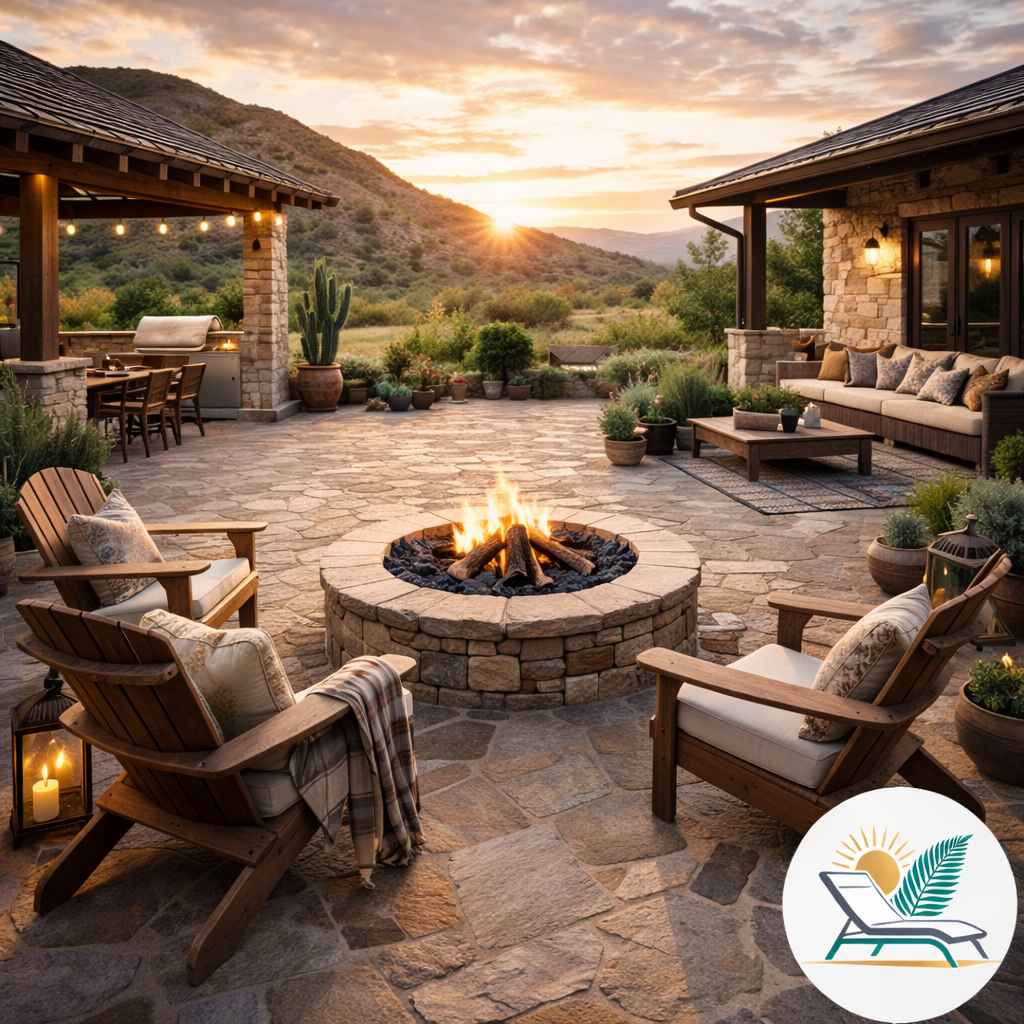


A ranch patio fails in a loud, expensive way. Wind flips lightweight chairs. Sun cooks cushions into brittle shells. Dust turns “neutral stone” into a constant cleaning chore. And the big one—space makes people careless, so the layout sprawls until nobody knows where to sit, where to eat, or where the fire goes without smoke chasing everyone off. Ranch style patio ideas work when they’re built for the realities: hard use, wide footprints, and weather that doesn’t negotiate. The decision isn’t whether it looks Western. It’s whether it stays comfortable after the third gathering, the first storm, and the fifth time someone drags a cooler across the surface.
Build a ranch footprint that feels intentional, not empty
Ranch style patio ideas usually fail at the same moment: the slab gets poured, the furniture lands, and the space still feels thin. Too much “open” reads as unfinished because the eye has nothing to land on.
Start by treating the patio like a room with edges, even if it’s out in a wide yard. Define a main zone that fits the way people actually sit—tight enough for conversation, wide enough for boots and traffic. The constraint is scale. Large ranch yards tempt oversized layouts, but bigger isn’t better when shade and lighting can’t keep up.
A common failure mode is drifting furniture. Pieces migrate with each hangout until the fire pit is off-center, the chairs face nowhere, and the walking path cuts through the seating. Fix it by choosing one decision lever early: anchor the center with a permanent element. A stone fire feature, a heavy coffee table, or a fixed rug-like paver inlay stops the layout from dissolving.
Picture a family outside Fort Collins with a wind-prone yard and kids who sprint through any open gap. They tried “more space” and got chaos—chairs scattered, snacks everywhere, nobody staying put. Once they tightened the main seating zone and made a clear “lane” to the grill, the same square footage started working like a planned space instead of a parking pad.
Choose materials that tolerate dust, boots, and temperature swings
If you’re committed to ranch style patio ideas, commit to surfaces that don’t punish you for living on them. The romance of pale stone disappears when it shows every footprint and every breeze-carried grit.
The constraint here is maintenance. If the patio needs weekly scrubbing to look presentable, it will lose. Textured concrete with a light sand finish, tumbled pavers, brick in warm clay tones, or natural flagstone with forgiving color variation can all read Western without looking like a theme set.
The failure mode is picking “pretty” over practical. Smooth, dark surfaces show dust and heat up fast. Soft stone can spall in freeze-thaw areas. Cheap pavers can shift when the base wasn’t compacted for heavy foot traffic. Your decision lever is the surface texture and color. Choose mid-tone, variegated materials that hide dust and don’t turn into a skillet by noon.
Ranch style patio ideas also benefit from edges that can take abuse. Metal edging, thick stone borders, and properly set joints keep the patio crisp even when people drag chairs, coolers, or firewood across it.
Create shade that looks Western and performs in real weather
Shade is not décor. It’s the difference between a patio people use and a patio people avoid. Ranch style patio ideas lean into pergolas, timber frames, and deep overhangs, but they only work if they’re sized for sun angles and wind.
The constraint is exposure. In many ranch settings, there’s nothing to block sun and gusts. A small pergola centered on a huge slab looks nice in photos and useless at 2 p.m. when the shade lands in the wrong place.
The failure mode is under-building. Lightweight fabric sails flap, stretch, and eventually tear. Small umbrellas become projectiles. The decision lever is coverage area and attachment method. Choose a shade structure that covers the seating zone first, not the entire slab. If you want fabric, tension it properly and use hardware that’s meant to stay put.
A workable move: put shade where people sit longest—usually the conversation zone—then let the dining or grill zone handle partial sun. Ranch style patio ideas aren’t about covering everything; they’re about controlling the worst conditions so the space stays usable more days per year.
Set up seating that handles groups without turning into a furniture shuffle
Big yards invite big gatherings. The problem is that big gatherings expose weak seating plans. Ranch style patio ideas should feel relaxed, but relaxed doesn’t mean random.
The constraint is flexibility. A ranch patio often hosts family, neighbors, kids, and whoever shows up with a cooler. The seating needs to expand without blocking paths or forcing people to perch on retaining walls.
The failure mode is relying on too many light, matching pieces. They slide, tip, and scatter in wind. They also make the space feel like a showroom instead of a ranch. Your decision lever is weight and modularity. Use heavier chairs or benches as the backbone, then add a few movable extras that store easily. Built-in seating along one edge creates a reliable “always available” line without cluttering the center.
A lived-in scenario: one couple near Amarillo hosted ten people on a patio designed for four. Every time someone arrived, they started hunting chairs from the garage. They replaced two single chairs with a long bench and added two compact stools that tuck under a console. Same footprint, no scramble, and the seating still looked Western instead of crowded.
Place the fire feature so smoke doesn’t chase everyone away
Fire is a ranch staple, but it’s also the quickest way to ruin a good night. Ranch style patio ideas often default to “fire in the middle,” yet wind and rooflines can turn that into a smoky mess.
The constraint is airflow. Open land means unpredictable breezes. A fire pit centered on the patio might look balanced, but if the prevailing wind blows across it toward seating, people will spend the evening rotating like a compass.
The failure mode is choosing placement by symmetry instead of wind. The decision lever is orientation. Put seating upwind when possible, and keep the fire feature slightly offset so smoke has a clear path away from faces. If there’s a roof or pergola, be careful with clearance and soot.
Also, size matters. A tiny bowl in a huge space feels weak and encourages people to pile wood high. That’s when sparks and smoke get out of control. Ranch style patio ideas work better with a properly sized fire feature that burns cleanly and stays contained.
Build a grill and prep zone that survives traffic and grease
Outdoor cooking belongs in ranch style patio ideas, but it needs a plan beyond “grill near the wall.” Cooking creates heat, grease, and constant trips between inside and outside.
The constraint is workflow. If the cook has to cross the seating zone to reach the fridge door, people will get clipped by hot trays. If the grill is too close to the house, smoke and grease end up on siding and windows.
The failure mode is skipping landing space. One small side shelf isn’t enough for real gatherings. The decision lever is countertop and distance. Give the grill a heat-safe landing area and keep the path from kitchen to prep zone clean. Even a simple, built-in counter with a durable surface can change the entire patio experience.
Ranch style patio ideas often look best with materials that match the environment—stone base, metal accents, wood details—but the real win is functionality. A prep zone that stays organized keeps the rest of the patio calm.
Add wind control without making the patio feel boxed in
Wind is the silent bully of ranch patios. It knocks over drinks, dries out plants, and makes evenings feel colder than the temperature suggests. Ranch style patio ideas need wind strategy that still feels open.
The constraint is sightlines. Most people choose ranch living for openness, so tall solid walls can feel wrong. The solution is selective blocking: partial screens, low walls, or planted windbreaks.
The failure mode is ignoring the direction of prevailing gusts. Adding a screen on the wrong side does nothing, then you end up stacking more barriers until the patio feels trapped. Your decision lever is placement. Block wind where it hits first—usually one corner or one side—then leave the rest open.
A good approach is a short, sturdy wall combined with planting that can survive heat and low water. Ranch style patio ideas don’t need lush, thirsty landscaping to feel finished. They need thoughtful protection where it counts.
Use Western lighting that keeps the mood without harsh glare
Ranch patios can be stunning at night, but lighting can wreck them fast. Bright, cool floodlights make the space feel like a work yard. Too little lighting makes people trip on steps and edges.
The constraint is power and placement. You may not have easy wiring across a wide patio, and ranch homes often have fewer exterior outlets than you want.
The failure mode is relying on one overhead source. It creates glare and sharp shadows. Your decision lever is layering. Combine warm wall fixtures near doors, low lighting along paths or edges, and a few focused points near seating. Metal lantern-style fixtures can fit ranch style patio ideas visually, but the real goal is comfort—faces lit softly, walking routes visible, and the rest allowed to fall into calm darkness.
Two small, warm light sources near seating will beat one bright light every time. The patio should feel like a place to stay, not a place to finish chores.
Anchor the look with ranch textures, not themed props
The fastest way to cheapen ranch style patio ideas is to decorate like a gift shop. Rope accents, fake wagon wheels, and novelty signs don’t create a Western feel. Materials do.
The constraint is restraint. Ranch style is strong when it’s honest—wood grain, weathered metal, leather-like textures, stone, and simple shapes.
The failure mode is overdoing motifs. Once every item points at “Western,” nothing feels real. The decision lever is one dominant texture plus one accent material. For example, heavy timber with blackened steel, or warm stone with rust-toned metal.
A clean move: choose furniture with simple lines and durable fabric, then add character through a single standout piece—maybe a long reclaimed wood table, a steel-framed bench, or a stone water trough-style planter. Ranch style patio ideas should feel earned, not staged.
Keep the patio clean by designing storage into the layout
Wide patios collect clutter. Toys, blankets, grill tools, dog leashes, and random cushions pile up fast. Ranch style patio ideas need storage that looks like part of the property, not a plastic afterthought.
The constraint is exposure. Wind and sun punish anything left out. Storage has to be tough, weather-resistant, and easy to use.
The failure mode is “temporary” storage that becomes permanent junk. The decision lever is built-in capacity. Add a bench with hidden storage, a slim cabinet near the grill, or a storage wall that doubles as a wind break. If you can store cushions quickly, you’ll use the patio more because setup and cleanup stop feeling like work.
This is where ranch style patio ideas become real-life friendly. When the space resets fast, people stop avoiding it. The patio stays ready, and that’s what makes it feel like part of the home.
Conclusion
Ranch style patio ideas succeed when they stop chasing a look and start managing conditions. Space is not a feature if it creates wandering layouts. Sun is not “nice” when it makes the seating unusable. Wind is not “fresh air” when it turns dinner into a juggling act. The first move is to choose your anchor—shade over seating, or a fixed centerpiece that locks the layout—because everything else organizes around it. The failure to avoid is building a large slab without edges, wind strategy, or storage, then trying to decorate your way out of discomfort. “Good” looks like this: people sit in the same places each time because the zones make sense, cleanup takes minutes instead of an hour, and the patio still works when the weather is less than polite. That’s ranch style, properly done—practical, durable, and calm.
What materials fit ranch style patio ideas in dusty areas?
Choose mid-tone, variegated surfaces like tumbled pavers, textured concrete, or flagstone. They hide dust better and don’t show every footprint after wind.
How do ranch style patio ideas handle strong wind without walls?
Use partial screens, low stone walls, and planted windbreaks placed on the gust-facing side. Block the first hit, keep the rest open.
Where should a fire pit go in ranch style patio ideas?
Place it with prevailing wind in mind, often slightly off-center. Keep seating upwind when possible so smoke moves away from faces.
How much shade do ranch style patio ideas really need?
Shade the main seating zone first. A solid cover over conversation seating matters more than covering every square foot of the patio.
What seating works best for spacious Western inspired layouts?
Use heavier core pieces like benches or substantial chairs, then add a few movable extras. It prevents constant rearranging and stands up to wind.
How do you stop a big patio from feeling empty?
Define edges and zones with a fixed anchor like a fire feature or paver inlay. Tighten the seating area so the space reads intentional.
What lighting suits ranch style patio ideas without glare?
Layer warm lighting: soft wall fixtures, low path lights, and a couple focused points near seating. Avoid one harsh overhead light.
How should a grill area be set up on a ranch patio?
Keep a clear path from kitchen to prep zone, add real landing space, and place the grill away from siding and windows to reduce smoke and grease.
What décor choices make ranch style patio ideas look authentic?
Rely on real textures—wood, stone, weathered metal—rather than themed props. One strong material pairing reads more genuine than many motifs.
How do ranch style patio ideas stay tidy for families?
Build storage into the plan: bench storage, a small cabinet near the grill, or a storage wall that also blocks wind. Fast reset keeps it usable.
Can ranch style patio ideas work on a smaller slab?
Yes, by scaling the zones and prioritizing shade and seating. Tight layouts can still feel Western through materials and one strong anchor piece.
What’s the biggest mistake with spacious Western inspired layouts?
Pouring a huge slab with no wind plan, no shade priority, and no storage. The patio becomes exposed, cluttered, and awkward to use consistently.